The short answer
Apple Valley’s tap water is only moderately hard, averaging 97 mg/L in Liberty Utilities’ report on 2025. The bigger cause is evaporation. An uncovered pool can lose 12,000 to 31,000 gallons a year, per the EPA, and every top-off leaves its minerals behind, so the calcium in the pool keeps climbing.
Apple Valley’s tap water isn’t the hardest in Southern California, yet the white line on pool tile here keeps coming back. Liberty Utilities’ own water report and the EPA’s numbers on pool evaporation explain why, and what helps.
How hard is Apple Valley’s water?
Liberty Utilities serves much of Apple Valley, and its Consumer Confidence Report on 2025 lists the water’s hardness at an average of 97 mg/L, with samples from 27 to 200 mg/L depending on the well. That is 5.7 grains per gallon on average, and 1.6 to 11.7 across the range. The same report lists calcium at an average of 31 mg/L (11 to 62) and total dissolved solids at an average of 265 mg/L (120 to 580).
The US Geological Survey classes water by hardness: 0 to 60 mg/L is soft, 61 to 120 moderately hard, 121 to 180 hard and anything over 180 very hard. So the average Apple Valley tap is moderately hard, and the hardest samples in the report are very hard.
Victorville, Hesperia, Adelanto and the other Victor Valley cities have their own water suppliers, and each one publishes its own yearly report with the same hardness line in it. If you want to know what your top-off water is adding, that report is the place to look. It is free, it comes out every year, and it lists hardness in the same units your pool test kit uses.
In that report, the line to look for is hardness, usually written as hardness as calcium carbonate (CaCO3). Liberty’s report for Apple Valley lists it two ways: 97 ppm, which is the same as mg/L, and 5.7 grains per gallon. Pool test kits use ppm, so that is the number to compare.
The report lists calcium on its own line as well, 31 ppm on average in Apple Valley. The two aren’t measured the same way. Hardness is written as calcium carbonate and counts magnesium too, which Liberty describes as the sum of those minerals, mostly calcium and magnesium, so it always reads higher than the calcium line.
Hold the hardness number up against two others. The USGS bands tell you how hard the tap water is. The 200 to 400 ppm that Pool Research suggests for a pool tells you where the pool should sit. Apple Valley’s tap is well below that range, which is why the problem here is what evaporation does over time rather than the water on the first day.
Evaporation does most of the work
The EPA’s WaterSense guide says a pool’s evaporation depends on temperature, humidity and wind speed, and estimates that an uncovered 500 square foot pool loses 12,000 to 31,000 gallons a year to it, depending on the climate, with heated pools losing more. The High Desert, with its hot summers, dry air and steady wind, sits at the hard end of all three.
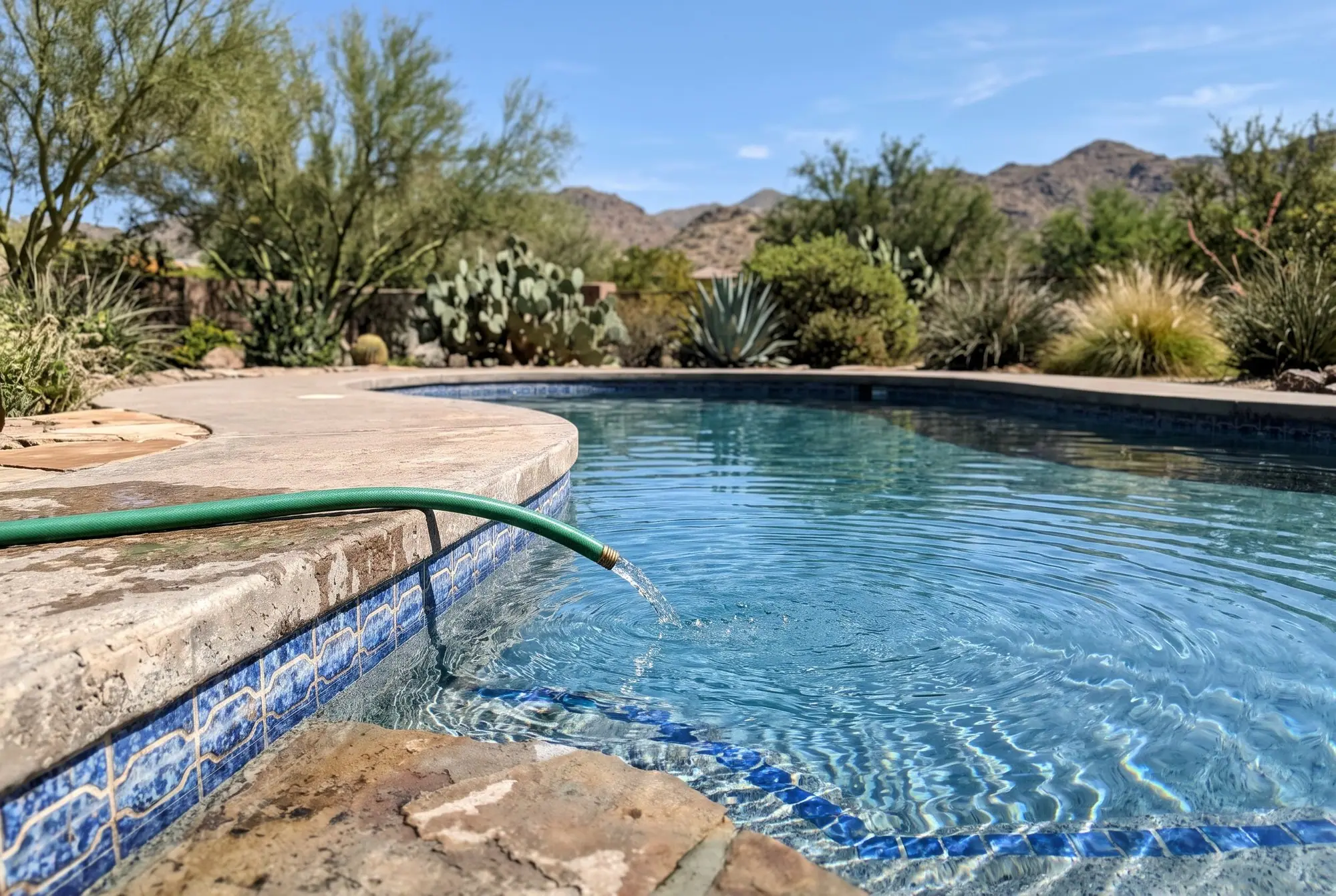
Here is the part most people miss: when water evaporates, the minerals in it stay in the pool. Then the top-off brings in new water with its own minerals. At Apple Valley’s average of 97 mg/L, replacing 12,000 to 31,000 gallons adds roughly 10 to 25 pounds of hardness minerals, measured as calcium carbonate, to the pool every year.
Nothing takes those minerals back out except draining some of the water or removing the scale by hand. So the longer a pool goes without a partial drain, the more mineral-heavy its water gets, and the more readily calcium comes out of it onto the tile, the rocks and the equipment. The EPA calls evaporation one of the leading causes of water loss in home pools, especially in hot, dry places, so in summer it outweighs the little that splash-out and backwashing send away.
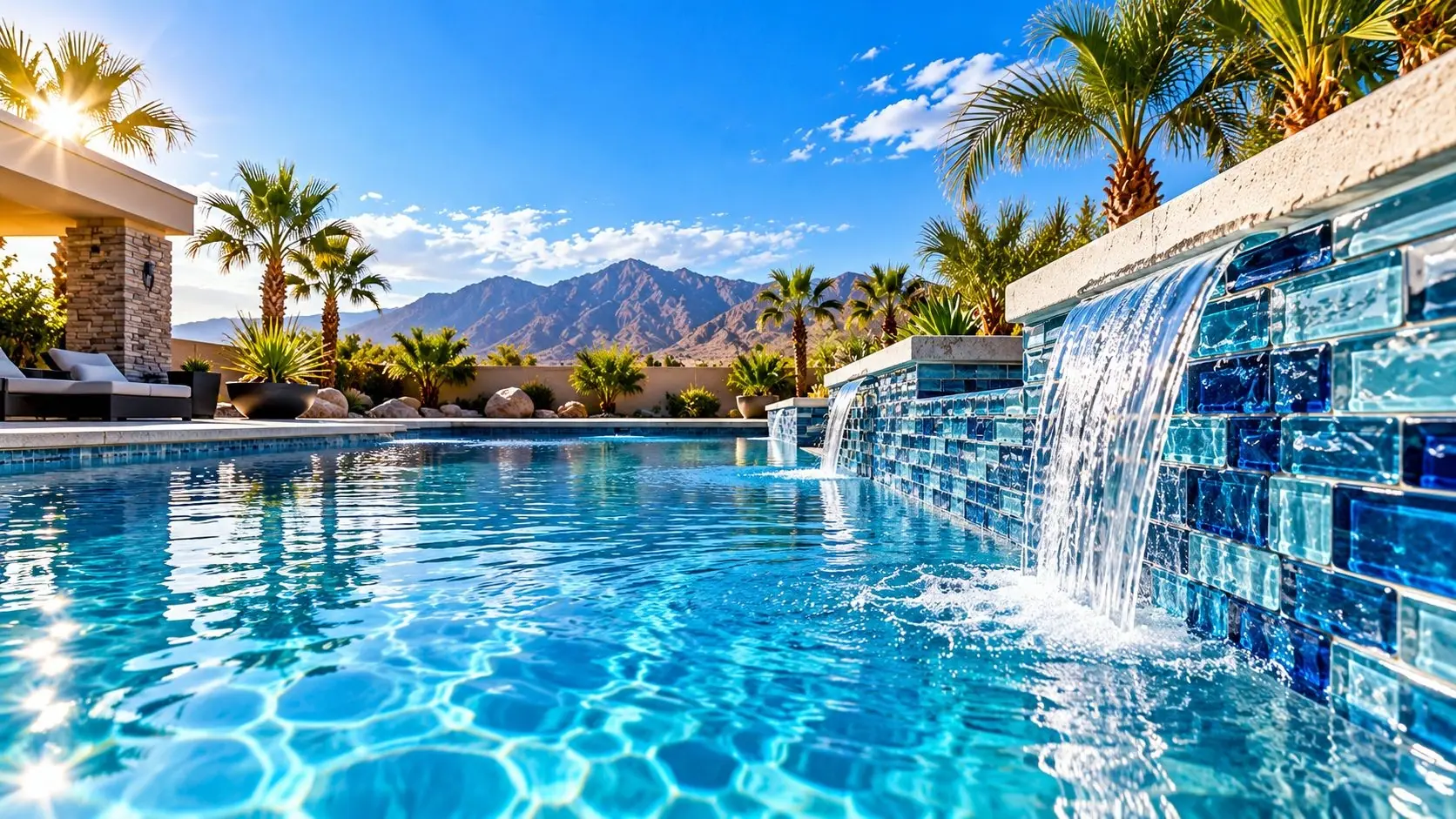
Why it ends up on the tile
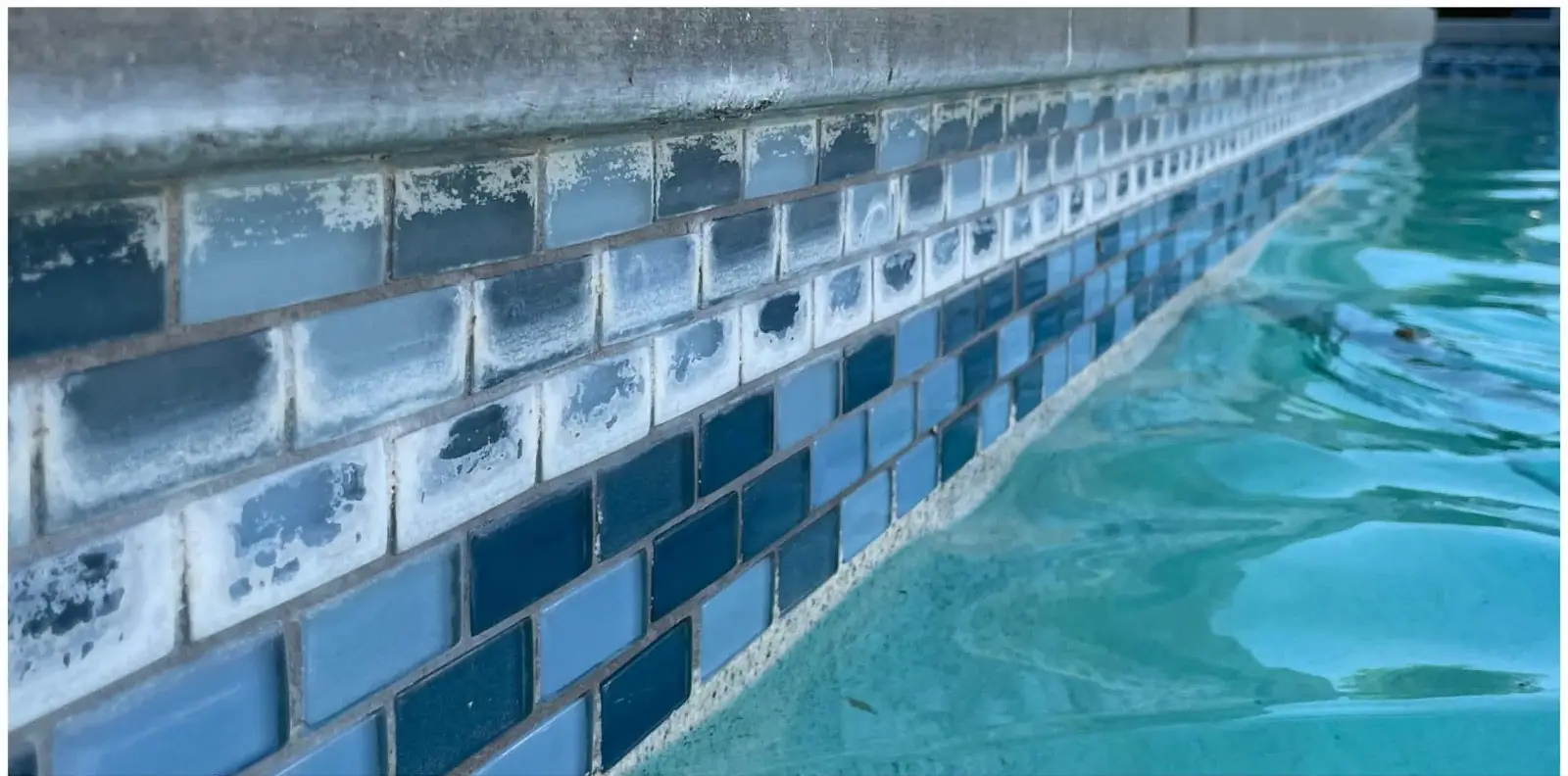
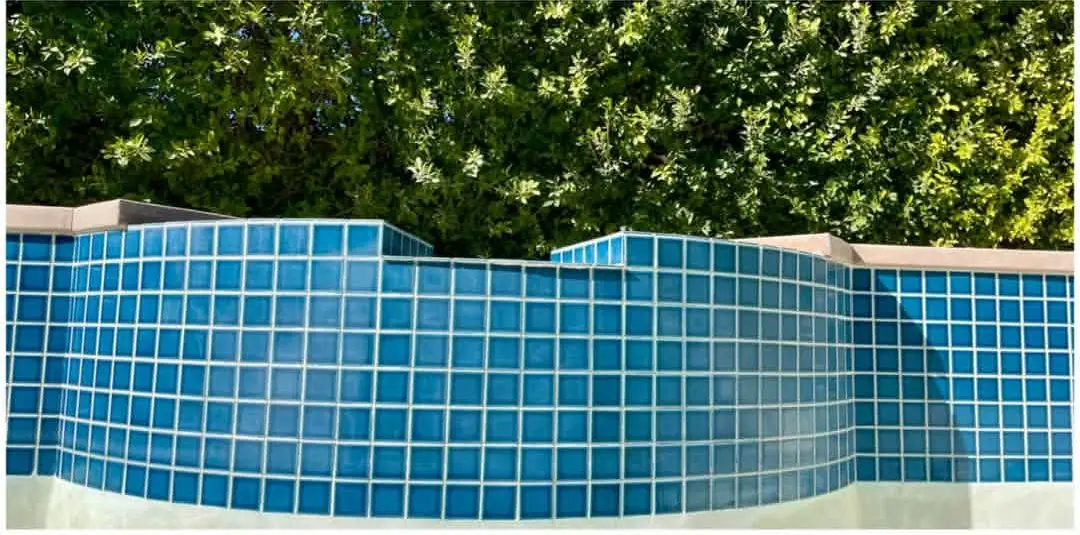
The waterline is where the water and the air meet, so it is where the evaporating happens. Lunada Bay Tile, a pool tile maker, calls the waterline the place where evaporation is highest. Splashes dry on the tile, the water level rises and falls an inch or two between top-offs, and each time a thin film of minerals is left behind. Layer by layer, that becomes the white or gray band you see.
Orenda, a pool chemical maker, explains why that band counts as scale even though it sits above the water: water evaporated off the tile, the calcium in what was left became more concentrated, and it came out as a solid. Orenda also says carbonate scale forms first where the water is warmest and the pH is highest, which is one reason it shows up faster in summer and on spas.
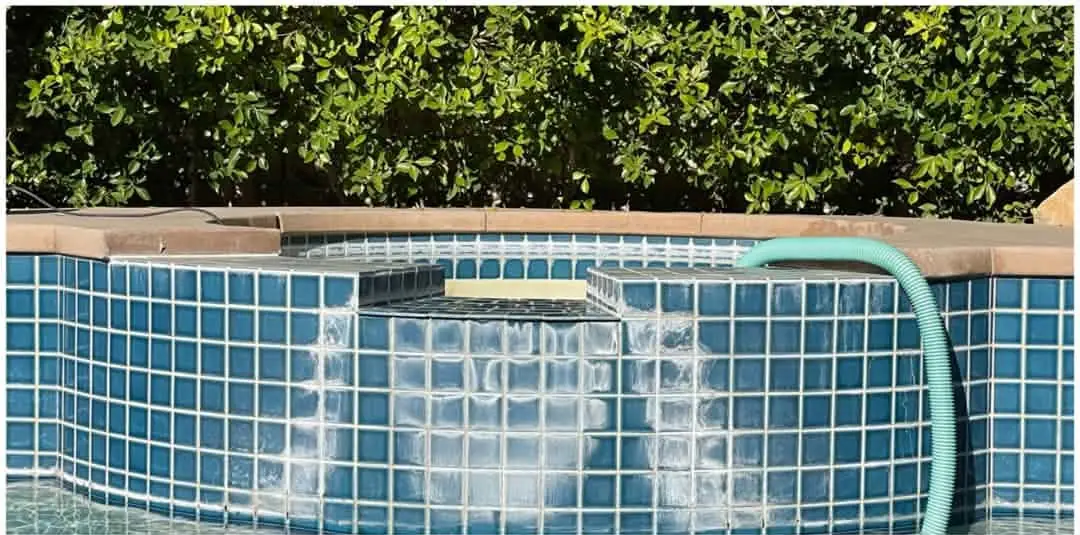
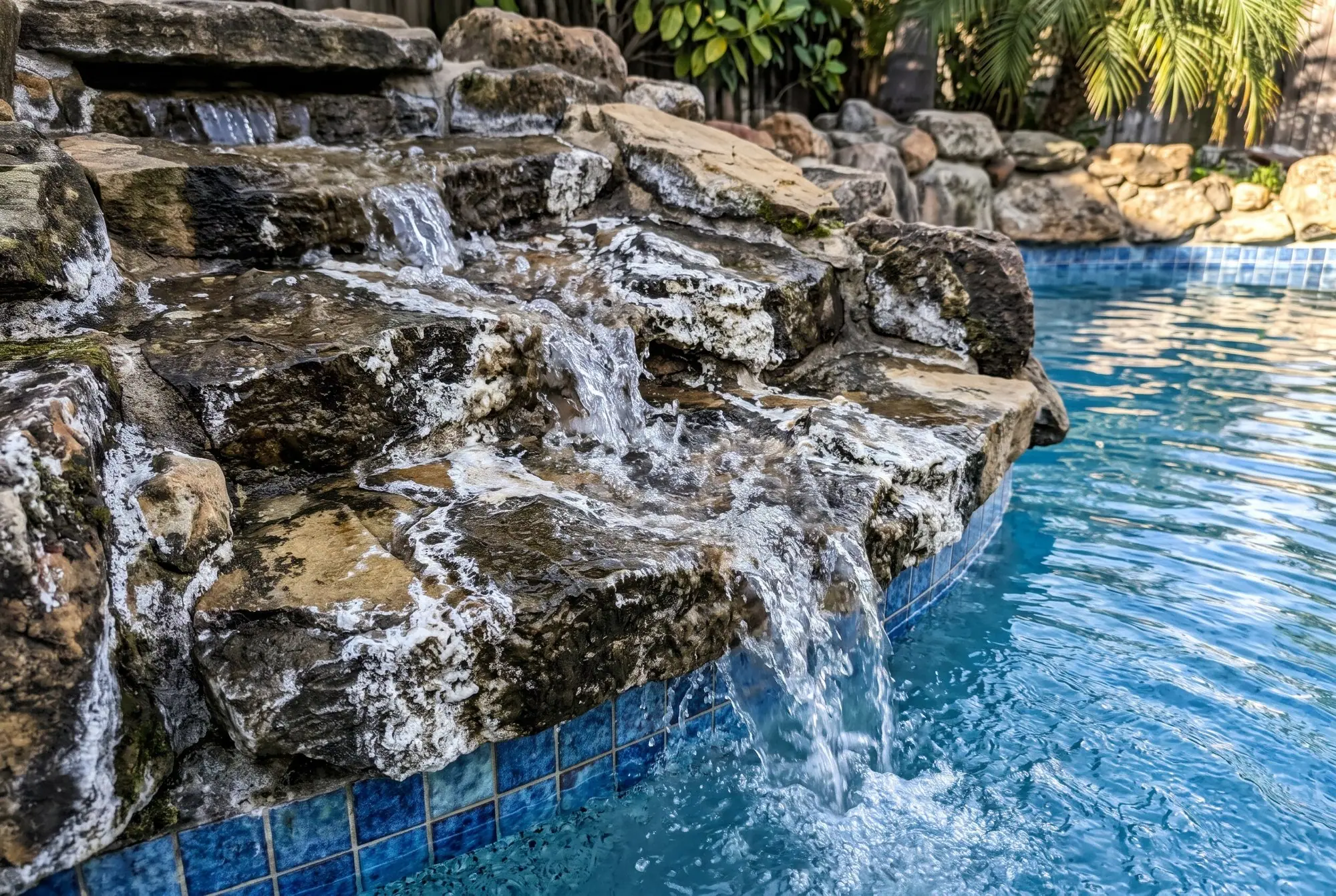
Rock waterfalls, sheer descents and fountains get the same treatment, because water runs over them and dries in the sun. That is why waterfalls and fountains so often carry white streaks right where the water runs.
It isn’t only the calcium number
Hard water gets the blame, but it is rarely the only cause. Orenda says calcium hardness is usually not the driving factor behind scale unless the numbers are very high, and that it takes a mix of other things, like water temperature and pH, to push calcium out of the water. Latham Pool makes the same point: pH can have a bigger effect on calcium scaling than calcium levels do.
Pool people measure the whole mix with the saturation index (LSI), which combines pH, temperature, calcium hardness, alkalinity and dissolved solids into one number. Orenda says carbonate scale comes from an index above +0.30. The National Plasterers Council recommends keeping it between 0.0 and +0.3, so the water neither eats the plaster nor drops scale.
For calcium on its own, Pool Research suggests 200 to 400 ppm and says anything over 400 can cause scale and cloudy water. It recommends alkalinity of 80 to 120 ppm and pH of 7.4 to 7.6. A pool store test or a good home kit gives you all of those numbers.
Tile isn’t the only thing it coats
Scale comes out of the water, so it lands wherever the water touches. Orenda says it forms on any surface, whatever it is made of: plastic fittings, metal ladders, tile and lights. It also gives a quick check. If the white is only on the cement and nothing around it, it probably isn’t scale at all, but something like plaster dust or etching.
Saltwater pools have one more place to look. Orenda explains that the flakes that build up inside a salt cell are calcium carbonate too, formed because the water inside the cell runs out of balance. Hard water and evaporation feed that buildup the same way they feed the tile line.
Pool Research adds a warning about the harder kind. Calcium silicate builds slowly, so by the time it shows on the walls it has often reached the filter and the pipes as well. In the yard, rock waterfalls, sheer descents and fountains turn white wherever water runs over them and dries in the sun.
What slows it down
A cover is the biggest single step. The EPA says solid pool covers can cut evaporation by more than 90 percent while they are on, and that in the 2016 Residential End Uses of Water study only 15 percent of pool owners had one and used it regularly. Its table puts solid and mesh covers at up to 95 percent, solar bubble covers at 50 to 95 percent, and liquid evaporation products at about 15 percent. The EPA also suggests a windbreak and more shade, which matter in a windy, sunny place like the High Desert.
Less evaporation means less top-off water, and less top-off water means fewer new minerals. The rest is routine:
- Use a cover whenever the pool isn’t in use, especially on hot, windy days.
- Test pH, alkalinity and chlorine once or twice a week, and calcium hardness, stabilizer and dissolved solids once a month, as the National Plasterers Council recommends.
- Brush the waterline every week with a soft brush or a non-abrasive pad while the buildup is still soft, as Lunada Bay Tile advises.
- Keep an eye on spa spillovers and waterfalls, where water dries fastest.
The EPA guide also notes that some water utilities offer rebates on pool covers. Ask your water provider whether yours does.
Lowering the calcium already in the water
Once the calcium in the pool is high, chemicals can’t take it back out. Pool Research says the main way to lower calcium hardness is to drain part of the pool and refill it. In Apple Valley that works in your favor: tap water averaging 97 mg/L is well under the 200 to 400 ppm a pool should hold, so swapping out part of the water brings the number down.
Draining has rules of its own in California. Pooldial’s summary of the state rules says pool water can’t go into storm drains, that most local agencies want the chlorine down to 0.1 ppm or less and the pH between 6.5 and 8.5 first, and that the local wastewater agency should be called before a big drain. Some agencies allow the water onto landscaping when it meets their standards.
A partial drain is also a good moment to deal with the tile, since the line is easier to reach with the water down. Ask about it if you are planning one.
When the line won’t brush off
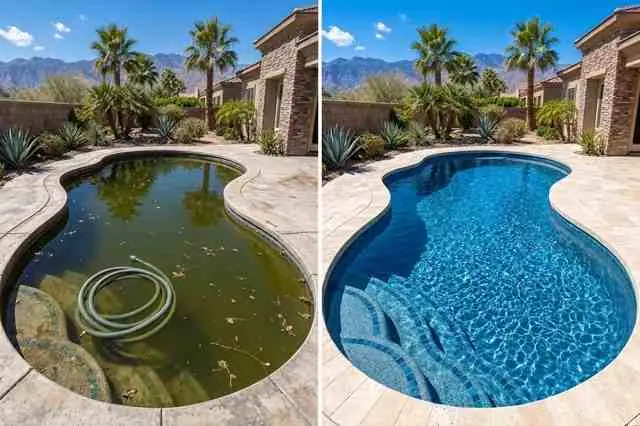
Once calcium has hardened onto the tile, brushing and household cleaners won’t move it, and scraping can scratch the tile. That is the point to have it removed properly. Revive’s pool tile cleaning uses media blasting to take the calcium off and bring the tile’s color back, usually in a few hours with the water lowered about 6 inches.
Orenda notes that grinding or bead blasting can clear a tile line, but that it doesn’t fix the water that caused it, so the scale comes back unless the balance and the evaporation are dealt with too. That is why the cover, the testing and the weekly brush above matter just as much after a cleaning as before one. ThePricer adds that after any partial drain, the pH, alkalinity, calcium and stabilizer should be tested again, so deposits don’t form again quickly on the clean surface.
If you aren’t sure what kind of buildup you have, this guide shows a simple test. Or text a photo of your tile to (760) 885-4462 and we’ll tell you. We’re based right here in Apple Valley and work across the Victor Valley, including Victorville, Hesperia and Adelanto.
Questions people ask
Is Apple Valley’s water hard?
Moderately. Liberty Utilities’ report on 2025 lists an average hardness of 97 mg/L, with some wells up to 200 mg/L.
Where can I see my own water report?
Your water supplier publishes a Consumer Confidence Report every year. Liberty Utilities posts Apple Valley’s on its website, and Victorville, Hesperia and Adelanto each have their own supplier.
Does a pool cover really help with calcium?
It helps a lot. Less evaporation means less top-off water, and the top-off water is what keeps adding minerals.
What calcium level should a pool have?
Pool Research suggests 200 to 400 ppm, and says anything over 400 can cause scale and cloudy water.