The short answer
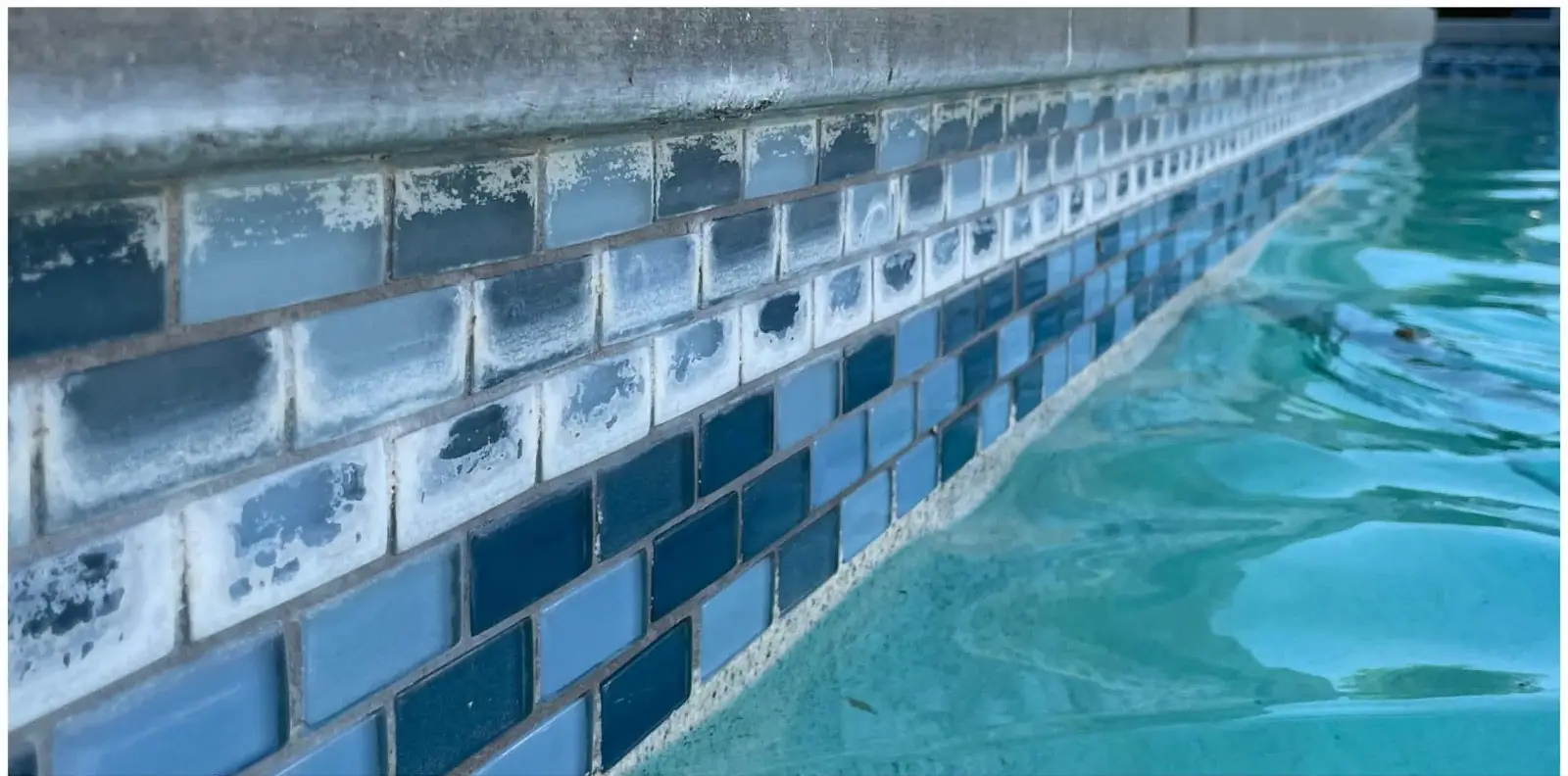
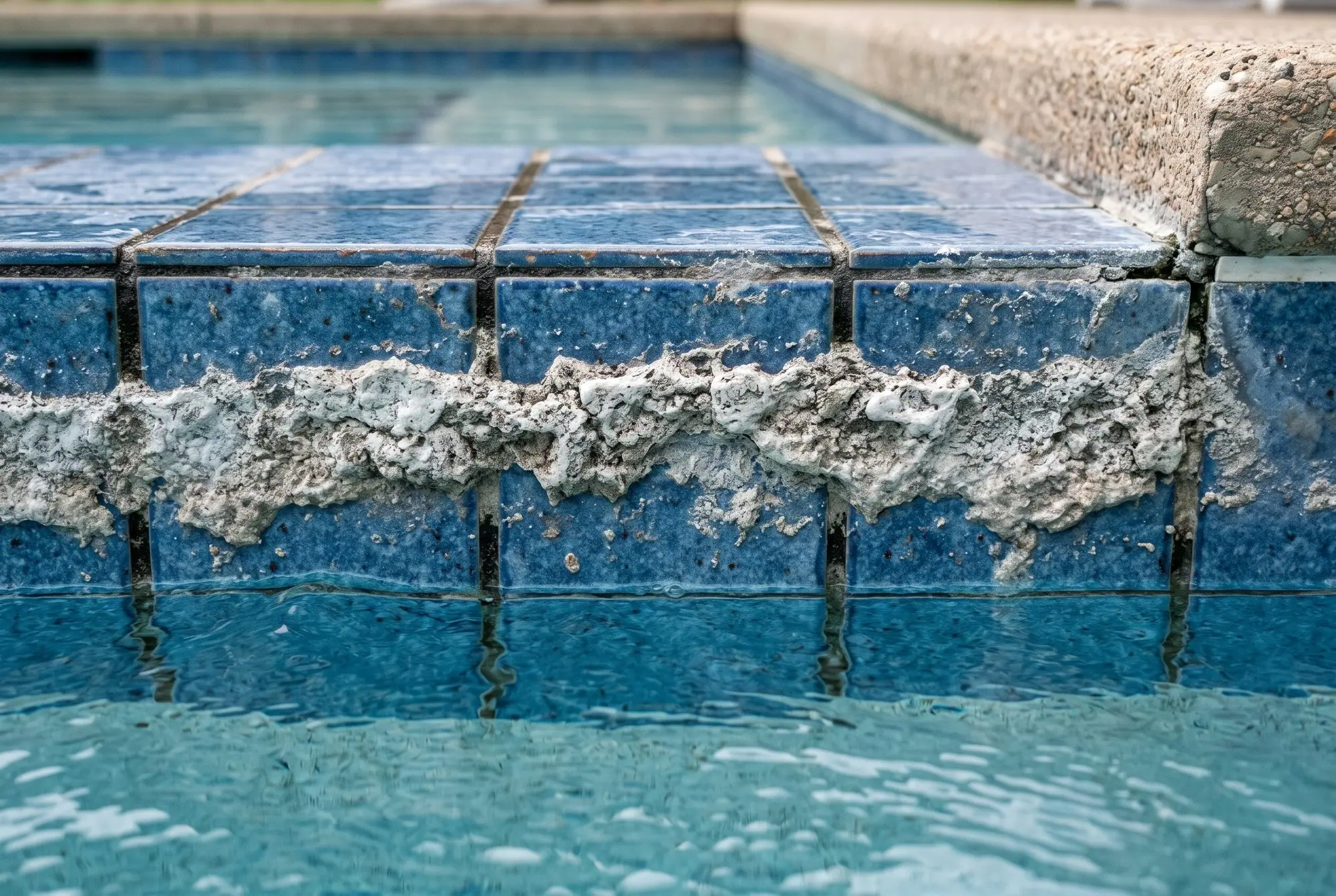
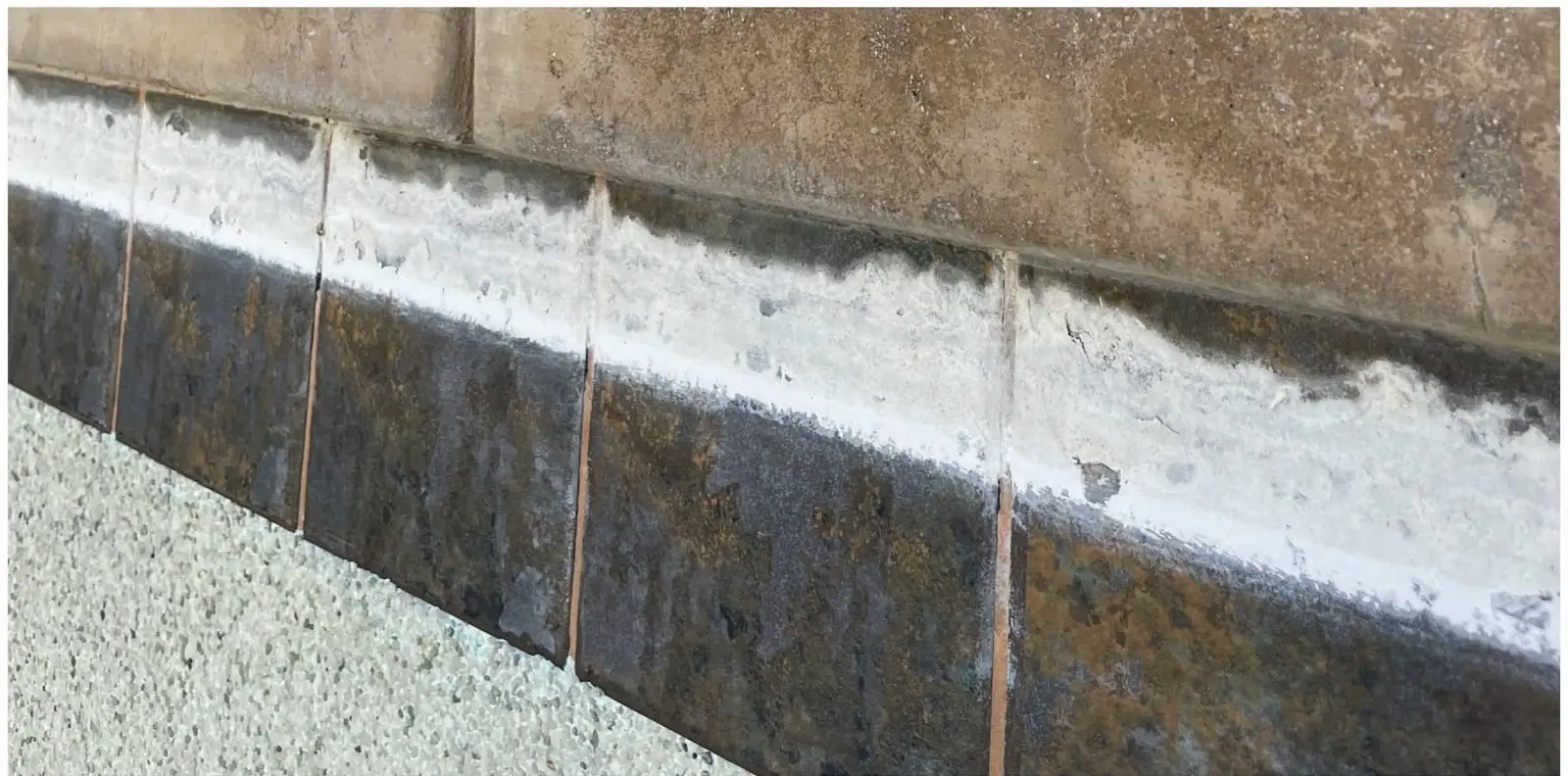
Calcium carbonate is white and flaky, and it fizzes when a drop of acid touches it. Calcium silicate is white-gray and doesn’t react, according to Poolonomics. Carbonate can often be scrubbed off. Silicate usually needs a professional to remove it.
A white or gray line on the tile is one of two things, and which one it is decides whether a brush and a pumice stone will move it. Here is how to tell them apart at home, what removes each, and how to keep both from coming back.
The two kinds of calcium scale
Both kinds start the same way: pool water evaporates, the calcium in it stays behind, and it settles at the waterline. What it turns into depends on the water and on time.
Poolonomics describes calcium carbonate as the most common kind, white and flaky, and fairly simple to remove. Latham Pool says the same: carbonate is white and flaky and fairly easy to take off, while silicate is white-gray and harder to move. A pool can have both.
Pool Research adds two details that matter. Calcium silicate is grayer and builds more slowly than carbonate, so by the time it shows on the tile it has often already built up inside the filter and pipes too. And a big silicate problem usually needs a professional.
Orenda, a pool chemical maker, notes that carbonate is by far the most common scale, and that the rarer kinds, made with silica, sulfate or phosphate, are much harder to remove. Telling them apart matters, because the method that works on one does nothing to the other, and the wrong tool on the hard kind is how tile gets scratched.
How to tell which one you have
The quick test is a drop of acid. Poolonomics uses a few drops of muriatic acid on the deposit: if it fizzes and bubbles, it is calcium carbonate, and if nothing happens, it is calcium silicate. Pool Research describes the same test and the same result.
Muriatic acid is strong and corrosive. The CDC counted an estimated 13,508 emergency room visits from pool chemical injuries in 2015 to 2017, most of them at homes, so wear gloves and eye protection and follow the label. If the tile is glass or ceramic, test a loose flake instead of the tile itself, since Lunada Bay Tile, a pool tile maker, says never to put muriatic acid directly on glass or ceramic tile.
A gentler home version is a few drops of plain white vinegar, which is a much weaker acid. A clear fizz still means carbonate. With vinegar the reaction is slower, so give it a minute before deciding nothing happened. Test in two or three places, since a long tile line can carry soft scale in one spot and hard scale in another.
- Fizzes, and the spot softens: calcium carbonate.
- No fizz, and it feels like rock: calcium silicate.
- Fizzes on top, hard underneath: both.
Why calcium carbonate forms
Orenda explains carbonate scale as water holding more calcium carbonate than it can keep dissolved, so it gives some up as a solid. Pool people measure that with the saturation index (LSI), and Orenda says carbonate scale comes from an index above +0.30. The National Plasterers Council recommends keeping the index between 0.0 and +0.3.
The line on the tile is a special case. Orenda calls these evaporation lines: water evaporates off the tile, the calcium in what is left becomes more concentrated, and it comes out as a solid right there. It also says carbonate scale forms first where the water is warmest and the pH is highest.
High calcium on its own is rarely the whole story. Orenda says calcium hardness is usually not the driving factor unless the number is very high, and Latham says pH can have a bigger effect on calcium scaling than calcium levels do. In practice, a pool with high pH, high alkalinity and hot water will scale even with ordinary tap water, and a pool kept in balance can hold a lot of calcium without dropping it on the tile.
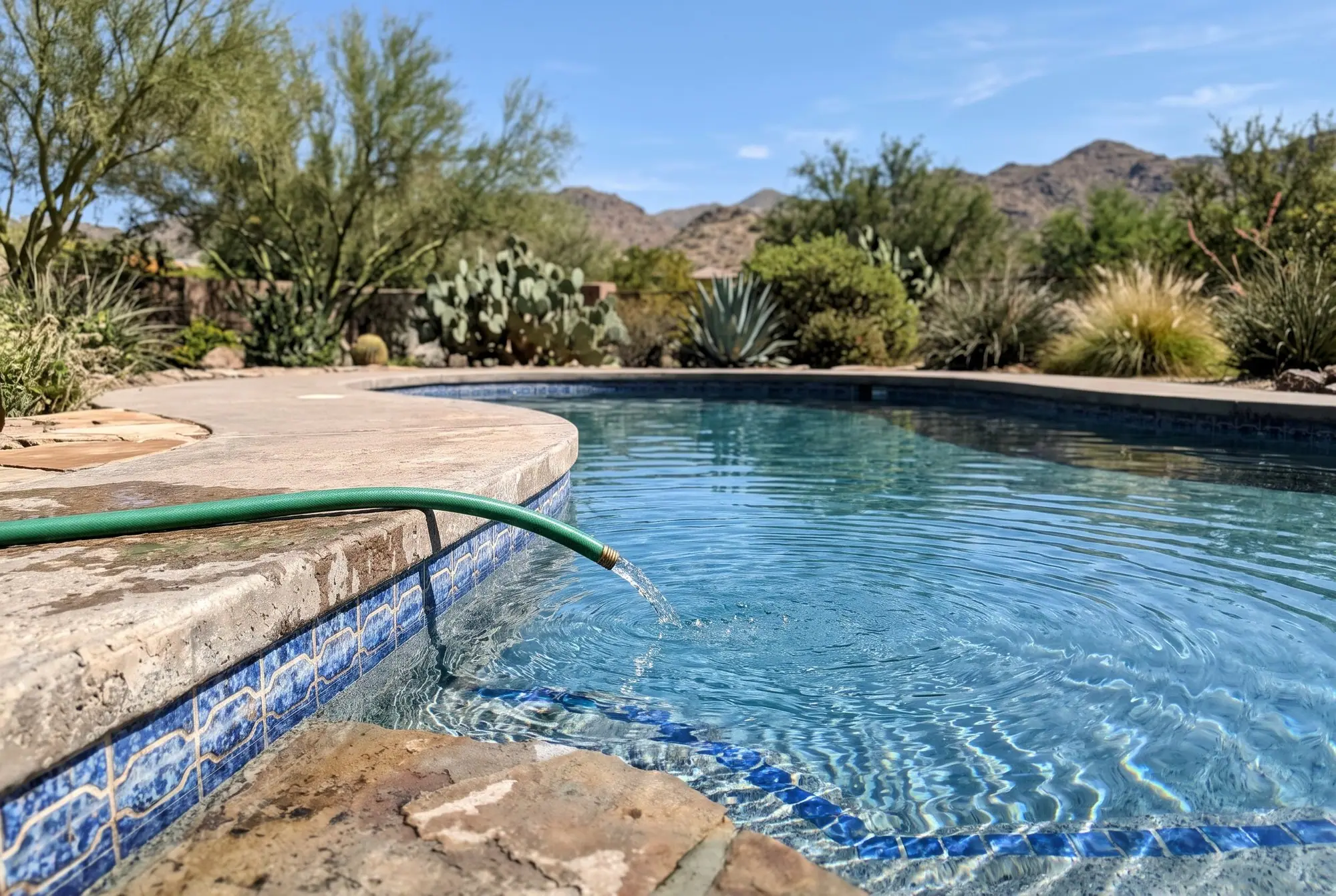
That is why the fix for carbonate is partly chemistry. Removing the line is the first step. Keeping the pH and alkalinity in range is what stops the next one. Pools in hot, dry places like the High Desert lose more water to evaporation, which keeps concentrating what is left, so the balance is worth checking often.
White deposits that aren’t scale
Not every white mark is scale, and Orenda warns that even pool professionals mix them up. Scale comes out of the water, so it lands on everything the water touches. If the white is only on the cement and nothing around it, it is more likely etching, mottling, plaster dust or calcite crystals in the finish. Orenda also notes that acid cleaning something off doesn’t prove it was scale.
One of its examples is a white band made by pouring undiluted acid around the edge of a pool. The acid eats into the cement, pulls calcium to the surface, and that calcium turns pure white. A home acid test done carelessly can leave a mark of its own, which is one more reason to keep the acid off the finish.
Orenda also covers the rare kinds. Calcium phosphate rates a 5 on the Mohs hardness scale against 3 for calcium carbonate, so it is much harder to remove, and it turns up mostly in the heaters and filters of commercial pools. The flakes that build up inside a saltwater pool’s salt cell are calcium carbonate, not phosphate.
Removing calcium carbonate
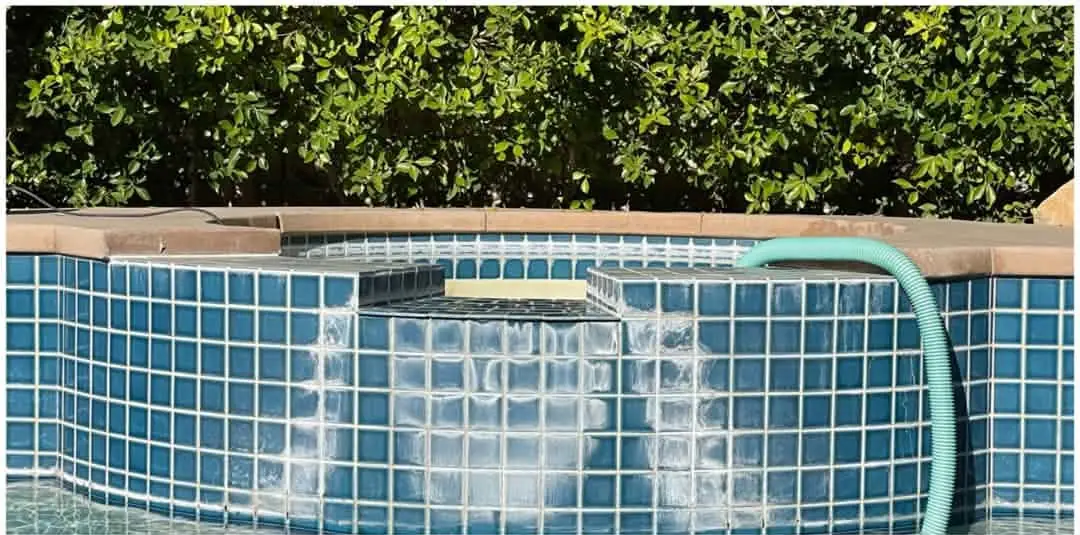
Carbonate that is still soft can often be removed by hand. Poolonomics describes lowering the water a few inches below the scale line, keeping a pumice stone and the wall wet, and rubbing in slow circles until the scale comes off. ThePricer adds that light scale often responds to a descaling chemical as well.
Pool Research lists three tools for carbonate: a pumice stone, a stain eraser and a calcium scaling treatment that is added to the water and dissolves the deposits over a few weeks. It warns that the pumice stone must be kept wet, or it can leave permanent scratches, and that it should never be used on a soft liner. Tile and concrete are the right surfaces for it.
Check that whatever you use is safe for your tile first. Glass tile and some decorative tile scratch easily, and a scratch is permanent. ThePricer says do-it-yourself descalers and pumice carry a real risk of scratching glass tile or etching stone.
Lunada Bay Tile recommends equal parts vinegar and water with a few drops of a non-detergent soap for routine cleaning, left on for about 10 minutes and scrubbed with a soft brush. Brushing the waterline every week keeps new carbonate from hardening in the first place.
Removing calcium silicate
Silicate doesn’t react to acid, so the products that work on carbonate won’t move it, and scraping it off by hand risks the tile. Poolonomics says silicate usually needs a professional. Pool Research says a lot of elbow grease with a pumice stone might shift it, but that the scale treatments added to the water can take months to work, if they work at all.
ThePricer notes that moderate to heavy scale usually needs media blasting at low pressure, and Orenda lists grinding or bead blasting as ways to clear a tile line. That is what Revive’s pool tile cleaning does: media blasting takes the hard scale off and brings the tile’s color back without replacing it. See how bead blasting works for what happens on the day.
Thick or hard scale takes longer to remove, and silicate can take more than one pass. Most home pools are still done in a few hours, with the water lowered about 6 inches and no draining.
Because silicate often means the plumbing has scale too, it is worth having the filter and the heater looked at while the tile is being cleaned. Pool Research notes that pool service companies often have stronger chemicals for silicate, which is another reason it usually ends up with a professional.
Where else calcium shows up
The same thing happens anywhere pool water runs and dries. Rock waterfalls and grottos get white streaks where the water flows, spillways crust over, and fountains build calcium on every tier. Orenda adds ladders, lights and plastic fittings to the list, since scale forms on any surface the water touches. See rock and grotto cleaning and fountain cleaning.
Rock and stone need more care than tile. ThePricer notes that soft stone needs gentler work with more masking, and that hand scraping takes longer where media can’t be used. If you aren’t sure what a rock is made of, ask before putting any acid on it.
White buildup on brick, block and stone walls is often something different: efflorescence, the salts that water carries out through masonry and leaves on the surface when it dries. It looks similar and needs its own approach. See efflorescence removal.
If the tile, the waterfall and the walls all need it, one free estimate covers them all.
Keeping it from coming back
Scale forms faster when the water is out of balance. Poolonomics recommends keeping pH between 7.2 and 7.6 and alkalinity between 80 and 120 ppm. Pool Research suggests calcium hardness of 200 to 400 ppm and says anything over 400 can cause scale and cloudy water. The way to lower calcium that is already high is a partial drain and refill.
The National Plasterers Council recommends testing pH, alkalinity and chlorine once or twice a week, and calcium hardness, stabilizer and dissolved solids once a month. Lunada Bay Tile recommends brushing the tile weekly at the waterline, where evaporation is highest.
Less evaporation helps too, since every top-off adds new minerals. The EPA says a solid cover can cut evaporation by more than 90 percent while it is on. In the High Desert and the Inland Empire, where heat and wind pull water out of a pool fast, that makes a real difference. Here is why Apple Valley pools build calcium so quickly.
If you would rather have a pro look at it, text a close-up of your tile to (760) 885-4462. We work across the High Desert and the Inland Empire, from Hesperia to Yucaipa.
Questions people ask
Can calcium silicate be removed with acid?
Not with the acid you would use at home, since it doesn’t react to it. Poolonomics says it usually takes a professional.
Is the white crust on my rock waterfall the same thing?
Usually, yes. Water evaporating off the rock leaves calcium behind. We clean suitable rock, grottos and water features too.
Should I use a pumice stone on glass tile?
Check with the tile maker first. Glass tile scratches easily, and some makers advise against abrasive methods of any kind.
Does calcium silicate mean my pipes have scale too?
Often. Pool Research says silicate builds slowly, so by the time it shows on the tile it has often reached the filter system as well.